A distribution company earns money only on the electricity it measures, bills, and collects. Every unit lost to theft, faulty metering, billing gaps, or unpaid dues is bought from generators but never paid for. That gap is what AT&C (aggregate technical and commercial) loss measures, and it is the most direct link between metering and a DISCOM's finances.
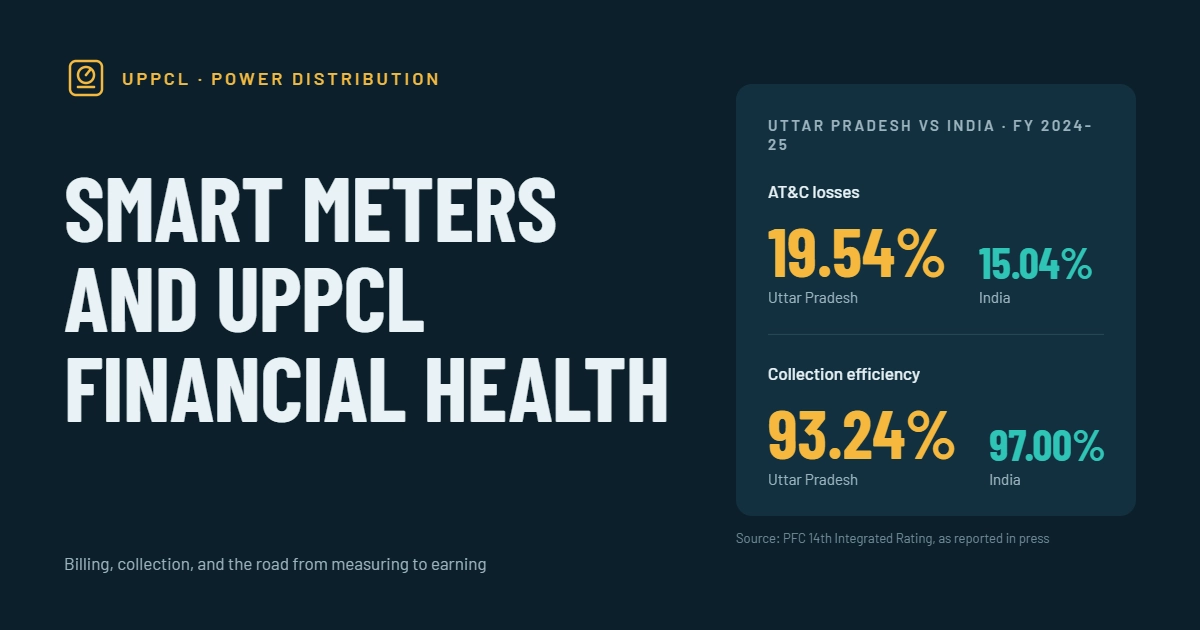
Uttar Pradesh sits at the centre of this. The state's AT&C losses were 19.54 percent in FY 2024-25, down from 22.18 percent in FY 2022-23 but up from 16.39 percent in FY 2023-24. The national figure for the same year was 15.04 percent. The trend in UP is uneven rather than steadily improving, which is the real finding.
The West vs. East Divide: PVVNL (Meerut) and NPCL (Noida) consistently outpace their Madhyanchal(MVVNL) and Purvanchal counterparts due to a denser industrial/commercial consumer mix, leading to fewer distribution leakages and higher recovery rates.
What smart meters can improve:
Billing efficiency: The main bottleneck in the DIscom's financial health improvement is Billing. In the current scenario, billing is done by localized tender based on a cluster of 2 to 3 districts, having very little payout for Meter Readers. In Rural areas, only 30 to 40% of bills are made per month rest are Table Billing. Actual readings replace estimates and assessed bills. UP's billing efficiency reached 86.29 percent in FY25.
Theft and tamper detection. There is a provision for event logging in the smart meter, whose data can lead to theft identification and
Energy accounting. With meters at the consumer, transformer, and feeder levels, losses can be located instead of averaged. This matters for targeting capex and enforcement.
Collection (potentially). Prepaid mode was the strongest lever here because payment came before consumption. That is why the Centre's rules pushed it. A gazette notification required that consumers other than agricultural ones, in areas with a communication network, be supplied through smart meters in prepayment mode.
The collection question
This is where UP's story gets complicated. UP's collection efficiency in FY25 was 93.24 percent, against a national collection efficiency of 97.00 percent (the all-India figure comes from the same PFC rating cycle). A shortfall of several points in collection can cancel out the gains from better billing.
Also, perfect billing can not lead to perfect collection efficiency. Old arrears and current bill are being accumulated, leading to more Losses in terms of collection, thus AT&C.
This is the context for UPPCL's move back to postpaid mode. The UPPCL frames it as a consumer-convenience step, and the deposit recovery, arrears instalments, and no-disconnection windows are designed to ease the transition. From a financial-health view, the mode change shifts the model from "collect first" to "bill, then collect," so collection discipline now depends on bill delivery, due-date alerts, and follow-up.
Costs and credibility
Smart meters are a capital programme, and the costs fall on DISCOM books or consumers.
It should be noted that the O&M cost for the Smart meter would also be needed in case of good adoption, and this cost is higher than Normal meter. Thus, smart meter adoption does not automatically raise revenue realisation.
Pricing has also become a trust issue. Reports said that from 10 September 2025, UPPCL required smart prepaid meters for new connections, and consumers were charged ₹6,016 for single-phase and ₹11,341 for three-phase meters on an interim basis, using a cost data book from 2019 that covered an older meter standard. The same report said a refund of around ₹75 crore was expected once a revised cost data book was adopted.
The wider financial picture
Metering is one lever among several. Power purchase costs make up 70 to 75 percent of a DISCOM's cost structure, and DISCOMs have been unable to pass cost variations through tariffs, which has created book losses and regulatory assets. Uttar Pradesh is among six states that together hold nearly 67 percent of DISCOMs' gross debt nationally. Even a perfect metering rollout would not close the gap created by tariff-cost mismatch and subsidy timing.
Conclusion
Smart meters give UPPCL what it lacked for decades: a measured, verifiable record of who consumes what and when. That is a strong foundation for improving billing efficiency and targeting losses. But it is a foundation, not the building. Financial health also depends on collecting billed amounts, maintaining consumer trust, controlling power purchase costs, and aligning tariffs with costs. UP's recent AT&C record shows that metering gains can be offset when collection slips.
Have questions about this article or your electricity bill?
Post your question in our Community Q&A Forum to get verified answers from engineers and consumers.
Ask in the Community Forum →
💬 Reader Discussion 0 comments
Share your thoughts, questions, or field experiencesNo comments yet
Be the first to share your thoughts, clarification, or question regarding this article!